Como a exposição solar influencia hormônios além da vitamina D?
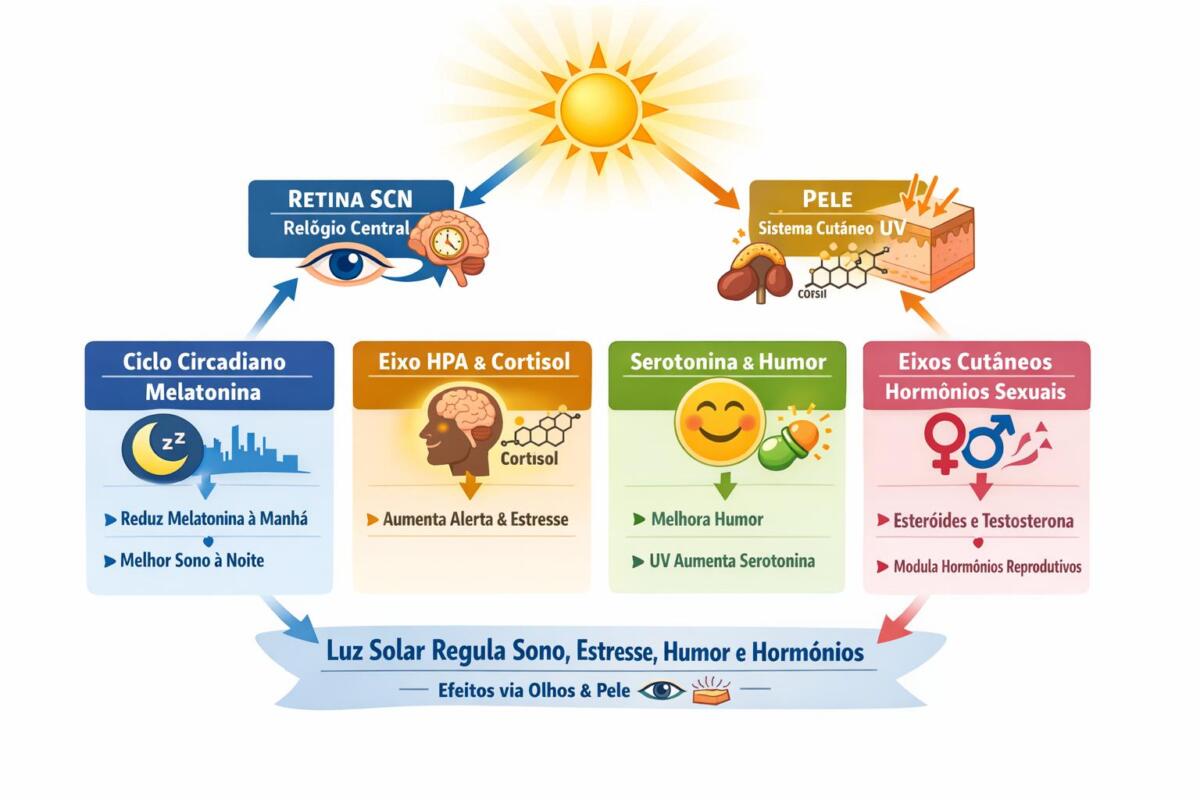
A luz solar regula vários eixos hormonais além da vitamina D, via retina–SCN (relógio central) e também por um “sistema neuroendócrino cutâneo” ativado por UV, com efeitos sistêmicos mensuráveis [1]1[2]2
Melatonina e ciclo circadiano:
A luz BLOQEIA rapidamente a melatonina noturna: quedas começam em ~5–18 minutos sob luz intensa, com recuperação lenta quando a luz cessa A luz da manhã reduz melatonina e alinha ritmos, enquanto ausência de luz (p.ex., ambientes sem janela) associa-se a melatonina mais baixa à noite e pior sono/humor
Exposição ocular, não “extraocular” na pele, é necessária para fasear ritmos de melatonina/cortisol
Cortisol e eixo HPA (adrenal) :
Transições de luz fraca para forte no início da manhã elevam cortisol imediatamente (>50%) e modulam alerta; efeitos dependem do horário e do espectro, com azul/verde produzindo aumentos maiores que vermelho De manhã, luz intensa e azul aumentam cortisol salivar versus luz fraca/vermelha; a intensidade importa
À noite, a luz gera padrões distintos de ativação/inibição do cortisol conforme duração e intermitência da exposição
Serotonina, humor e SOL:
A luz diurna está ligada a maior liberação central de serotonina e melhor humor; redução sazonal de luz relaciona-se a queda de serotonina e depressão sazonal .
Em humanos, UVA pode elevar transitoriamente serotonina sérica e reduzir melatonina, com melhora subjetiva de equilíbrio/ansiedade, sugerindo via cutânea além da retina
Eixos cutâneos e esteroides sexuais
RAIOP UVB ativam no pele um “HPA cutâneo” (CRH, POMC, ACTH, β‑endorfina) e produção local de cortisol, com sinais que podem alcançar o eixo central; efeitos variam por comprimento de onda A
A pele também sintetiza precursores esteroides (via CYP11A1), modulados por UVB, potencialmente influenciando hormônios sistêmicos Em modelos murinos e dados humanos observacionais, UVB aumentou hormônios sexuais e correlacionou-se com maior testosterona/agressividade/paixão, implicando um eixo pele‑cérebro‑gônadas mediado por p53 epidérmico
Em mulheres pós‑menopausa, maior UVR associou-se a estrogênios mais baixos e gonadotrofinas mais altas, indicando que UV pode alterar o balanço reprodutivo
Em síntese, a luz solar influencia melatonina (sono), cortisol (estresse/ritmos), serotonina (humor) e até esteroides sexuais através de vias oculares e cutâneas, além da clássica produção de vitamina D [2]2
_____________________________________________________________________________________
COMO A LUZ PELA MANHA INFLUENCIA O CORTISOL?
A luz azul de manhã pode aumentar a resposta de despertar do cortisol, especialmente quando a exposição é brilhante e nas primeiras 1–3 horas após acordar, em comparação com luz fraca ou vermelha [1]1[2]2.
Em estudos controlados, luz azul ou azul‑enriquecida elevou a área sob a curva do cortisol e a sensibilidade da resposta, indicando maior produção e subida mais acentuada após o despertar
A intensidade importa: luz brilhante aumenta o cortisol mais do que luz fraca, e espectros com mais componentes de onda curta (azul/verde) tendem a provocar respostas maiores do que vermelho [1]1[2]2
O que os dados mostram:
- Comparações espectrais: Exposição pós‑despertar a azul/verde elevou o CAR versus vermelho; efeitos consistentes em desenhos cruzados com 1 hora de luz
- Magnitude/área: Maior saída total (AUCg, área sob a curva “ground”) e maior aumento (AUCi) com azul, sugerindo impacto tanto no total quanto na dinâmica da resposta
- Intensidade: Luz brilhante provoca os níveis mais altos de cortisol versus luz fraca, vermelha ou azul de baixa intensidade, destacando o papel da iluminância além do espectro
- Contexto adicional: Em manhãs com luz azul‑enriquecida, alterações metabólicas ocorrem sem diferenças claras no cortisol entre manhã e noite em alguns protocolos; porém a literatura sistemática conclui aumento do cortisol em manhãs com luz brilhante rica em azul/verde
Em síntese, luz azul matinal, especialmente brilhante, tende a amplificar o pico fisiológico de cortisol do despertar, com efeitos quantificáveis na área e no gradiente da resposta
| Aspecto Avaliado | O que foi comparado | O que os dados mostram | Interpretação Clínica/Fisiológica |
|---|---|---|---|
| Comparações espectrais | Luz azul/verde vs. luz vermelha (1h pós-despertar, desenhos cruzados) | Azul/verde aumentam o CORTISOL em relação ao vermelho | Espectros de menor comprimento de onda estimulam mais fortemente o eixo HPA no início da manhã |
| Magnitude total (AUCg) | Área total sob a curva de cortisol | Maior AUCg com luz azul | Aumenta a produção total de cortisol no período avaliado |
| Dinâmica da resposta (AUCi) | Incremento da resposta após despertar | Maior AUCi com luz azul | Intensifica a velocidade e amplitude da resposta ao despertar |
| Intensidade luminosa | Luz brilhante vs. luz fraca, vermelha ou azul de baixa intensidade | Luz brilhante gera os níveis mais altos de cortisol | A iluminância é fator determinante, além do espectro |
| Contexto metabólico | Manhãs com luz azul-enriquecida | Alterações metabólicas observadas; alguns protocolos não mostram diferença clara manhã vs. noite | Apesar de variações metodológicas, revisões sistemáticas indicam aumento do cortisol com luz brilhante rica em azul/verde |
REFERÊNCIAS BIBLIOGRAFICAS
[1] Slominski et al., “How UV Light Touches the Brain and Endocrine System Through Skin, and Why.”,
Endocrinology (2018).
https://pubmed.ncbi.nlm.nih.gov/29546369/
[2] Slominski et al., “Photo-neuro-immuno-endocrinology: How the ultraviolet radiation regulates the body, brain, and immune system.”,
Proceedings of the National Academy of Sciences of the United States of America (2024).
https://pubmed.ncbi.nlm.nih.gov/38489380/
[3] Skobowiat et al., “Cutaneous hypothalamic-pituitary-adrenal axis homolog: regulation by ultraviolet radiation.”,
American journal of physiology. Endocrinology and metabolism (2011).
https://pubmed.ncbi.nlm.nih.gov/21673307/
[4] Rahman et al., “Characterizing the temporal Dynamics of Melatonin and Cortisol Changes in Response to Nocturnal Light Exposure.”,
Scientific reports (2019).
https://pubmed.ncbi.nlm.nih.gov/31873098/
[5] Campbell and Jialal, “Physiology, Endocrine Hormones”,
StatPearls Publishing (2022).
https://www.ncbi.nlm.nih.gov/books/n/statpearls/article-814/
[6] Harb et al., “Lack of exposure to natural light in the workspace is associated with physiological, sleep and depressive symptoms.”,
Chronobiology international (2015).
https://pubmed.ncbi.nlm.nih.gov/25424517/
[7] Lindblom et al., “No evidence for extraocular light induced phase shifting of human melatonin, cortisol and thyrotropin rhythms.”,
Neuroreport (2000).
https://pubmed.ncbi.nlm.nih.gov/10757506/
[8] Leproult et al., “Transition from dim to bright light in the morning induces an immediate elevation of cortisol levels.”,
The Journal of clinical endocrinology and metabolism (2001).
https://pubmed.ncbi.nlm.nih.gov/11231993/
[9] Robertson-Dixon et al., “The Influence of Light Wavelength on Human HPA Axis Rhythms: A Systematic Review.”,
Life (Basel, Switzerland) (2023).
https://pubmed.ncbi.nlm.nih.gov/37895351/
[10] Petrowski et al., “The effects of light exposure on the cortisol stress response in human males.”,
Stress (Amsterdam, Netherlands) (2021).
https://pubmed.ncbi.nlm.nih.gov/32160826/
[11] Petrowski et al., “Increase in cortisol concentration due to standardized bright and blue light exposure on saliva cortisol in the morning following sleep laboratory.”,
Stress (Amsterdam, Netherlands) (2021).
https://pubmed.ncbi.nlm.nih.gov/32723201/
[12] Munir and Abbas, “Seasonal Depressive Disorder”,
StatPearls Publishing (2023).
https://www.ncbi.nlm.nih.gov/books/n/statpearls/article-126883/
[13] Munir and Abbas, “Seasonal Depressive Disorder”,
StatPearls Publishing (2023).
https://www.ncbi.nlm.nih.gov/books/n/statpearls/article-126883/
[14] Gambichler et al., “Impact of UVA exposure on psychological parameters and circulating serotonin and melatonin.”,
BMC dermatology (2002).
https://pubmed.ncbi.nlm.nih.gov/11952999/
[15] Jozic et al., “Skin under the (Spot)-Light: Cross-Talk with the Central Hypothalamic-Pituitary-Adrenal (HPA) Axis.”,
The Journal of investigative dermatology (2015).
https://pubmed.ncbi.nlm.nih.gov/25964265/
[16] Slominski et al., “On the role of skin in the regulation of local and systemic steroidogenic activities.”,
Steroids (2015).
https://pubmed.ncbi.nlm.nih.gov/25988614/
[17] Parikh et al., “Skin exposure to UVB light induces a skin-brain-gonad axis and sexual behavior.”,
Cell reports (2021).
https://pubmed.ncbi.nlm.nih.gov/34433056/
[18] Triebner et al., “Ultraviolet radiation as a predictor of sex hormone levels in postmenopausal women: A European multi-center study (ECRHS).”,
Maturitas (2021).
https://pubmed.ncbi.nlm.nih.gov/33541562/
__________________________________________________________________
COMO A LUZ PELA MANHA INFLUENCIA O CORTISOL?
Leproult et al., “Transition from dim to bright light in the morning induces an immediate elevation of cortisol levels.”,
The Journal of clinical endocrinology and metabolism (2001).
https://pubmed.ncbi.nlm.nih.gov/11231993/
[2] Scheer and Buijs, “Light affects morning salivary cortisol in humans.”,
The Journal of clinical endocrinology and metabolism (1999).
https://pubmed.ncbi.nlm.nih.gov/10487717/
[3] Petrowski et al., “The effects of post-awakening light exposure on the cortisol awakening response in healthy male individuals.”,
Psychoneuroendocrinology (2019).
https://pubmed.ncbi.nlm.nih.gov/31220690/
[4] Mekschrat et al., “IL-6 after wake-up in human males: Exposure to red versus blue light and the interplay with cortisol.”,
Brain, behavior, & immunity – health (2024).
https://pubmed.ncbi.nlm.nih.gov/39252985/
[5] Petrowski et al., “The inflammatory immune system after wake up in healthy male individuals: A highly standardized and controlled study.”,
Brain, behavior, & immunity – health (2022).
https://pubmed.ncbi.nlm.nih.gov/36093437/
[6] Robertson-Dixon et al., “The Influence of Light Wavelength on Human HPA Axis Rhythms: A Systematic Review.”,
Life (Basel, Switzerland) (2023).
https://pubmed.ncbi.nlm.nih.gov/37895351/
[7] Petrowski et al., “Increase in cortisol concentration due to standardized bright and blue light exposure on saliva cortisol in the morning following sleep laboratory.”,
Stress (Amsterdam, Netherlands) (2021).
https://pubmed.ncbi.nlm.nih.gov/32723201/
[8] Petrowski et al., “The effects of light exposure on the cortisol stress response in human males.”,
Stress (Amsterdam, Netherlands) (2021).
https://pubmed.ncbi.nlm.nih.gov/32160826/
[9] Clodoré et al., “Psychophysiological effects of early morning bright light exposure in young adults.”,
Psychoneuroendocrinology (1990).
https://pubmed.ncbi.nlm.nih.gov/2255748/
[10] Foret et al., “Effect of morning bright light on body temperature, plasma cortisol and wrist motility measured during 24 hour of constant conditions.”,
Neuroscience letters (1993).
https://pubmed.ncbi.nlm.nih.gov/8377945/
[11] Lemmer et al., “Effects of bright light on circadian patterns of cyclic adenosine monophosphate, melatonin and cortisol in healthy subjects.”,
European journal of endocrinology (1994).
https://pubmed.ncbi.nlm.nih.gov/8180675/